
Federal Prison Release Meaning
The Federal Bureau of Prisons is a nationwide sentenced-prison system. It is separate from Madison County Jail, MODOC, ICE civil detention, and USMS pretrial custody. No BOP institution was identified within Madison County. The person's home county, arrest location, or state conviction record does not establish a BOP facility assignment.
BOP explains that a past release date paired with no facility, or a location shown as RELEASED, means the person left BOP custody on that date. It does not mean every legal obligation ended. Federal supervised release may follow, and another state, local, or immigration authority can assume custody. The federal docket and the destination in a release or transfer record help distinguish those outcomes.
Search Federal Prison Releases
The official BOP Inmate Locator covers federal records from 1982 forward. Search by BOP register, DCDC, FBI, or INS number when one is known. The name search accepts first, middle, and last name, with age, race, and sex refinements. Use those fields to avoid joining a Madison County person to a namesake.
- Search by federal identification number when available because it is more precise than a name.
- If searching by name, try the full name and compare age, race, sex, and register number.
- Read both location and release date. A past date or RELEASED location addresses BOP custody only.
- Open the federal court docket to review judgment, sentence, release orders, and supervised-release terms.
- Request the BOP record when the locator does not explain destination, transfer, or a disputed date.
The Madison County released-inmate search path should be used for a county booking. A Madison County jail entry that names USMS or BOP can establish the handoff from local custody, while federal sources establish the later federal outcome.
The official search screen shows the federal name and number routes. View the source at the BOP Inmate Locator before comparing candidate records.
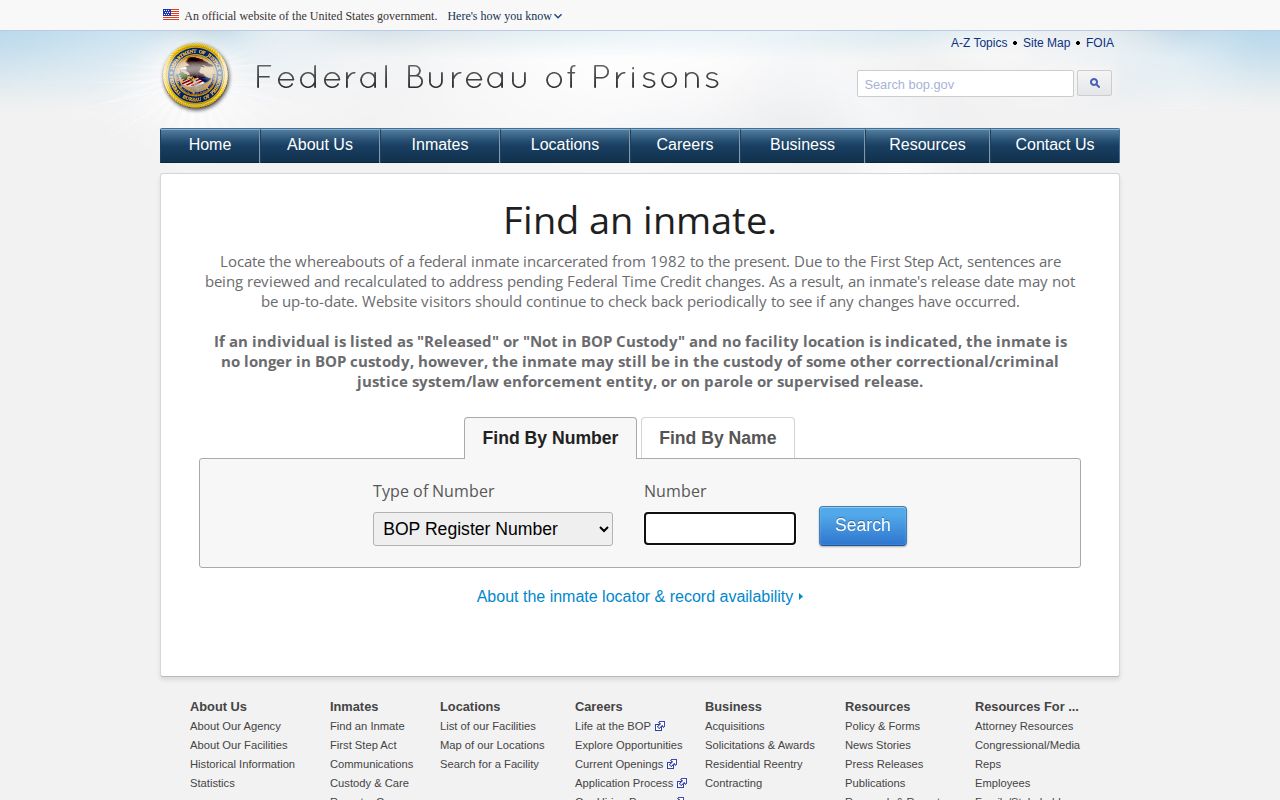
The locator is a national BOP tool, so a Madison County connection must be established with identifiers and the underlying federal case.
A number search is stronger than a name search. BOP accepts its own register number as well as DCDC, FBI, and INS identifiers. When only a name is known, use the available age, race, and sex refinements, then compare the candidate with the federal court district, case number, judgment, and approximate confinement period. A shared name or Madison County residence does not establish that the federal result belongs to the same person.
Read the location and date together. A facility name indicates a current BOP placement within the locator’s scope. A past release date with no facility, or a location of RELEASED, states that BOP custody ended on that date. It does not identify a later probation office, state warrant, immigration transfer, or other jurisdiction. The federal docket and any destination in the release record supply that missing context.
Federal Prison Records Contact
There is no Madison County BOP release desk because no federal prison was identified in the county. Current operational questions belong with the institution shown in the locator. Detailed historical, movement, or release records belong with BOP's federal records process, with identity certification when required.
Federal Bureau of Prisons release sources
BOP Inmate Locator: nationwide search
Federal docket: judgment and supervised-release orders
BOP FOIA: detailed custody and release records
NARA: older federal confinement records
For a focused request, supply full name, register number, birth date, federal court and case number, approximate confinement dates, and the facility if known. Ask for the actual BOP release date, release or transfer mechanism, destination when disclosable, and the record supporting any correction to the locator.
If the public result conflicts with the judgment or a known custody event, preserve the displayed register number, location, date, and search date. Ask BOP to identify the source record and correction route. Detailed records can require identity certification or other current agency procedures. A narrow request for the disputed date, movement, or release mechanism is more useful than a demand for every federal record connected to the person.
Federal Locator Record Fields
The official BOP locator record explanation states that results list the person's name, register number, age, race, sex, release date, and location. These fields help separate namesakes and establish the system's custody status. The release date can be historical or future. A future date is projected and may change.
| Locator field | Use and limit |
|---|---|
| Register number | Strong identifier for matching the federal record |
| Location | Shows a facility or RELEASED, but not every other authority |
| Past release date | Shows BOP custody ended on that date |
| Future release date | A projection that can change |
| Age, race, and sex | Refinements for namesake review, not substitutes for the register number |
BOP data updates daily. It does not serve as a live USMS pretrial locator or an ICE locator. A person held only by USMS may never appear, and an ICE civil detainee belongs in a separate system.
The release-date field can also be future-facing. BOP describes a future date as projected, so it may change as sentence computation, credits, court action, or custody status changes. Confirm an expected date with the institution shown in the result. Once the date passes, use the updated locator and the actual movement record rather than assuming that the projection became the release event.
Older Federal Release Records
The public BOP locator covers federal custody records from 1982 forward. Pre-1982 coverage is incomplete. For an older confinement, BOP directs researchers to the National Archives and Records Administration with the person's identifying facts and approximate confinement dates.
Do not treat an absent older result as proof that federal custody never occurred. Search the federal docket, identify the institution or case, and submit a focused historical request. Names, birth data, federal district, case number, register number if found, and approximate years can narrow the archive search.
For National Archives research, include the person’s full name, birth date, approximate confinement dates, known institution, federal district, and case details. An archive response may identify the custody record but still leave supervision questions to the court docket. Keep the archival confinement end date, the criminal judgment, and any later court order together so that an old federal release is not confused with a more recent Madison County custody event.
A historical release date still addresses BOP custody, not every later supervision term. Federal court records are the better source for supervised release and any later revocation. A state or county record may reveal a separate hold after the federal event.
Note: For an older federal case, pair the archive response with the judgment and docket instead of relying on locator absence.
Federal Detainers and ICE Transfers
Federal systems remain separate even when they touch the same person. ICE can request notice and up to 48 additional hours beyond an ordinary release point so DHS may assume civil immigration custody. No Madison-specific ICE contract was found. A BOP release date does not show whether ICE or another authority took custody afterward.
If a release or transfer record names ICE, use the ICE Online Detainee Locator and DRIL. If a Madison County record names USMS, inspect the federal docket and use the USMS FOIA route. USMS has no public historical released-person search, and BOP may have no result if the person never entered a sentenced BOP facility.
A detainer request alone is not proof of pickup. Confirm the receiving agency and date. Likewise, RELEASED in BOP is not proof of a community return if an immigration, state, or local hold existed.
Federal Release Versus Supervision
Federal supervised release is imposed through the federal court and follows the terms in the judgment. It is distinct from Missouri parole, MODOC conditional release, and Madison County probation. BOP's locator does not provide a full supervision history.
Use the judgment and later docket entries to confirm the supervision term, modifications, revocations, and court actions. The BOP release date establishes when BOP custody ended. The docket establishes the federal court's next legal stage. If another agency assumed custody, its record establishes the physical destination.
USMS is another distinct layer. It manages federal prisoner processing and maintains an internal tracking system, but it offers no public name-based historical release locator. A person held for a federal pretrial matter may never enter BOP. In that situation, the federal docket explains detention and release authority, while a focused USMS records request addresses the physical custody and disposition history.
That three-part review prevents a nationwide BOP result from being mistaken for a Madison County Jail disposition. It also prevents a local release event from being used to infer the outcome of a later federal sentence.